Thursday, December 9, 2010

RECIPE FAIL! - Veggie Burger #1

I can't believe it. It seemed so simple, and yet it fell to pieces so quickly. Literally. My veggie burgers failed me. Or I failed them. But I'm going to tell you about it anyway. I'm not going to tell you about why this entry should actually be called "Veggie Burger #3" and ways in which I might have made very similar mistakes twice before in the past year. Nope. Oh dear. I think it's important for all cooks to know that sometimes dinner is just a disaster, even if you think you're a good enough cook to blog about what you do in your kitchen. If you read to the end you might even see some light at the end of the tunnel.

I've done my research in cookbooks and online. I've asked friends for recipes, which I am still waiting to receive. Ahem. I've tasted many a veggie burger and taken mental notes on what I liked, what I didn't, and what I wanted my own burger to be as opposed to one I could easily just buy at the store and stick in my freezer. This past summer with its abundance of fresh veggies I decided I did, in fact, want to come up with something very similar to a Garden Burger [tm]. I tried a brown rice base, I tried a quinoa base, and I tried egg as binder, but oh yeah... we're not going to talk about that. Let's just say neither worked, the flavor was just pilaf-like, and after about 20 seconds they just fell apart into the aforementioned pilaf.

Now that it's cold I decided I wanted something heartier, something nothing at all like anything I can get at my closest store, and that it would be bound with something other than egg. Oh, and I was going to make it with whatever I already had in the house. This helped narrow things down nicely and I came up with a mushroom lentil burger that I was positive would taste amazing. It did, aside from the salt debacle referenced below, but with foods in patty-form you have to worry about more than just taste.

Veggie Burger #1

Ingredients:
- extra virgin olive oil
- onion, diced
- portobello or baby bella mushrooms, chopped
- white wine
- lentils
- veggie broth [didn't have any. I used a Rapunzel herbed vegan bouillon cube and hot water.]
- soy sauce [preferably tamari]
- spices such as basil, parsley, tumeric, thyme
- binder [I used my new old friend, grated taro]
- Worcestershire sauce
- salt & fresh ground pepper to taste

Directions:
Heat up the oil in your pot and add the diced onion. Cook them down until they're almost caramelized, or less depending on your taste for onion, then add the mushrooms and a pinch of salt. Once the mushrooms are warmed and beginning to let go of their juices in a minute or so, add a splash of the wine. Cook that down until the wine is just about gone and throw in your lentils. I like to heat my lentils a bit before adding water or stock.

Add a dash of tamari, a dash of worcestershire, and your spices and stir that all in. Add enough stock to cover the lentils and, stirring occasionally, cook covered for 30 minutes or more on low until the lentils are nice and tender. Use more stock or water if necessary. Remove from heat.

[Sounds easy so far, right? My first mistake was adding more than a pinch of salt to the mushrooms, then too much soy sauce, then the bouillon cube I used had sea salt in it! It had herbs in it, too, which was really handy and why I chose to use it in the first place, but OMG salt-'splosion!]

Now that you have a tasty pot of mushrooms and lentils, which you can easily eat on its own without going any further if you so desire, you're going to take 1/2 to 3/4 of what you've got and either mash it by hand or puree it in a food processor. Return that to the pot and mix it into the remaining whole lentils and mushrooms.

This is when you need to add your binding agent, and where things always start to go really wrong for me in Burger Land. I didn't have any egg in the house, but that's OK because egg didn't work for me last time anyway. Not that we're talking about that. What I did have was some more malanga / taro root, which I had heard could be used as a binding agent. Eureka! I mixed the grated taro into my lentils & mushrooms, scooped some out and formed a patty with my hands. Once you have formed your patties, all you have to do is spray a nonstick cooking pan with a bit of oil and fry each side up a little bit to form a crust to keep the burger together and you're all done. Right? Wrong.

Vegie Burger #1

In about 5 seconds, the whole thing fell apart. So what had I done wrong? I had had a tough day and this was the end of it? I was so frustrated, I actually decided to give up. Not one to waste food, especially tasty food, I scooped the remaining mixture into a few ramekins, packed each one in there really well, and baked them for 15 minutes at 350 degrees so I had a few portions of a sort-of lentil loaf to eat during the week.

Vegie Burger #1

And then it happened. I decided to have one for dinner that night to be eaten with a side salad. After letting it cool for a bit, I turned it out of the ramekin and onto a plate and there it was... in the words of Spongebob Squarepants, "The Perfect Patty".

Veggie Burger #1

Tuesday, November 30, 2010

New World Latkes - Malanga Fritters

Hanukkah begins tomorrow night at sundown. Rejoice! 8 days of gifts! Oh wait, that's not it. During this holiday, we celebrate one day's worth of lamp oil miraculously lasting for 8 days*, though the main miracle of Hannukah is that the Maccabees withstood the most powerful army in the world and were then able to worship as they chose. And, in the grand Jewish holiday tradition of "They tried to kill us. They couldn't. Let's eat!", one of the ways in which we celebrate this particular holiday and pay homage to both miracles is by using an abundance of oil in our cooking. Which pretty much means having a lovely fry-up, and perhaps even some donuts at the office.

This is when you, Dear Reader, think ahhhhh, I know where this is going: Latkes! Potato pancakes! Well sort of, but not quite. You see, last week my in-laws drove up from Florida a few days early to join my family for Thanksgiving. But forget the turkey and trimmings! My husband and his brother were eagerly awaiting Tuesday night's dinner, walking around with stars intheir eyes and salivating at the thought of my mother-in-law's Cuban home cooking - rice & beans, breaded fried steaks, and the main event: "Crunchies". All of which have "no real recipe, really, I just add alittle of this and that"... yup! It's a cross-cultural phenomenon.

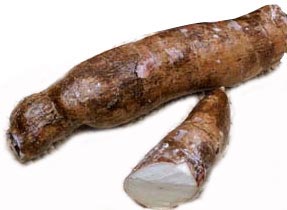
When my then-boyfriend, now-husband attempted to explain these mythical Crunchies to me a few years ago, in an effort to get me to cook him some I might add, my first thought was "What's wrong with regular latkes?!" My second was "I don't get it, what's the difference between this and a latke?!" He swore up and down the taste was completely and totally different. And better.** And that he didn't know how they were made, but they were like heaven. I was determined to learn more about them, but didn't get the chance until this past week. It turned out my biggest hurdle was that I simply didn't know anything about the vegetable itself! Neither what it was called nor what it looked like. Frankly, my problem was that I didn't think to google it once I knew the main ingredient was a mysterious root-like-vegetable called a
malanga, a word which my husband and I took turns completely forgetting. In my mind's eye I imagined it to be something very much like a potato or maybe, if I was feeling creative, a yuca. And if you don't know what one looks like, forget about going to a grocery store and asking where the malanga is, because everyone will look at you as though you have 37 heads and it turns out that "malanga" is just the Cuban name for it!

So where do we begin? If you like, you can read all about this fascinating cormel known as Xanthosoma sagittifolium here. But as far as this particular recipe goes, this is all you need to know: The malanga blanca is what you want. It has very bright white flesh inside. Watch out, because there is also a lavender variety, but if it's not labeled properly you can't tell you've got the wrong one until you've taken it home and cut into it. The outsides look the same on both varieties [they almost look like a yuca and a horseradish had a baby. Sort of.]

Malanga Fritters - malanga blanca

To make it even more confusing, they are also known as"Yautia", which is how my grocery store labels it, "Cocoyam", or "taro root", amongst a host of other names! When you choose one to buy, make sure it's sturdy and not mushy. When you bring it up to the cash register, I guarantee you they will look at it like it was dropped off by a UFO, then look you in your 37 sets of eyes, and ask you what the hell it is and how the hell they should ring it up. Then they'll argue that what you've brought them is in fact a yuca or, if they're caucasian, a horseradish. Pick your battles. Next time I'm just going to pay for my "yuca" and leave.

And what about the recipe? It is so simple, it's ridiculous. Check it out:

Malanga Fritters (Frituras de Malanga)

Ingredients:
- canola oil (enough for the frying pan)
- malanga / yautia
- salt

Directions:
Wash and peel the malanga and grate it on a box grater, on one of the finer sides. (It will grate up gooier than a potato. This is normal.)

Malanga Fritters - Peel it

Malanga Fritters - shred it

Add a little salt. Mix the salt in and mash it up with a fork a bit.

Malanga Fritters - mash it up

Heat the oil in your frying pan [use cast iron if you've got one for an excellent crispy crunch, otherwise nonstick will do]. When the oil is hot, drop the mix in by tablespoons. Fry until you can see the edges are turning golden brown.

Malanga Fritters - fry it till it's crispy on one side

Flip, squish the browned top down a bit with your fork or spatula to flatten the fritter out, and fry the other side. Place on a paper towel to get rid of some of the excess oil. Devour.

Malanga Fritters - flip 'n' squish

That's IT! That's all you need. And there I was, racking my brains for years. Nice. Now that I've done a little more research, I see some recipes calling for you to add things like egg, garlic, parsley, and vinegar to the mix, or even to boil the malanga first. I don't think any of that is necessary since they were delicious and held together nicely as they were, but one day I might experiment with spices. Or not. I know someone who would probably be very sad if I changed up his precious Crunchies!

Nerd Notes:
* Actually, that's debatable. According to the writings of some ancient historians, after the first day's use of oil the jug of oil refilled itself every day with enough oil to relight the Temple's great menorah [lamp / eternal flame], and this continued for 7 days, the amount of time it took to prepare new oil, which was the problem in the first place - it's not that there was no oil or means of procuring it, the oil just wasn't ready yet and they couldn't let the flame go out.

** Also debatable. I grew up with latkes and kugel, he grew up with Frituras de Malanga and Tostones. I love them both, but as to which is better... let's just say they're different!

Wednesday, November 24, 2010

How to cook without a recipe - Mushroom Gravy

Whenever I asked my grandmother for her famous kugel recipe she always replied "there's no recipe, really, it's just a bissel of this, a bissel of that..." ["a bissel" meaning "a little" in Yiddish]. Long story short, I never got that recipe. Nobody did. After experiencing the tragic loss of this epicurean delight which the entire family looked forward to every holiday and which we no longer have, I decided that even if you don't have the precise measurements most people associate with a recipe, it's worth writing it down anyway. So that is what this blog is all about - cooking it oldschool stylee, just like grandma used to make. Except maybe without the schmaltz.

So how do you cook without a recipe? Well, as long as you know the ingredients, the general proportions, and the order in which to add everything, you can generally make a pretty tasty dish. Especially if you adjust the ingredients and seasonings to your taste. But people, no matter what you do and how many times you helped in the kitchen, it will never ever taste 'just like grandma's'. This is just the Way of Things. And that is OK. Sometimes things need to change, even just a little. They can still be great.

I'm a pescetarian with an omnivore husband, an Italian and Austrian-Jewish family, and Cuban in-laws. This should make for an interesting recipe collection. It took me years to explain what a vegetarian and what a vegan, a real one, does and doesn't eat. Now that I've added fish back into my diet, I fear I've confused things again. More on that another time, but I bring it up because tomorrow is that most dreaded of holidays for vegans and vegetarians - Thanksgiving. After you have the "turkey is not beef, but it IS meat" argument, does the conversation continue like this:

"The stuffing is vegetarian!" they swore, reverently scooping it from the turkey's butt. "We just used a little chicken broth in it. You can eat chicken broth, right? It's not meat. Oh wait just a sec, let me pull the liver out of there for you..."

If so, you'll probably be wanting a few things you can eat at the table. Here is one that's a crowd-pleaser for veggies and meat eaters alike:

Vegan Mushroom Gravy

Ingredients:
- extra virgin olive oil [and a little butter or vegan margarine if you like a richer flavor]
- white or yellow onion, diced
- garlic, chopped
- baby bella mushrooms, chopped
- red wine
- flour
- veggie broth, preferably warm
- Bell's poultry seasoning [or sage, thyme, & marjoram]
- salt & pepper

Directions:
Basically your base is caramelized onions cooked slowly over low heat in olive oil [or a mixture of olive oil and butter/vegan margarine if you like a bit of richer flavor, or canola oil if you hate olive oil, which you shouldn't] until they are soft and almost sweet. The butter isn't necessary, but it is tasty and I usually do throw a bit in. If you like onions, use lots. If you hate onions, use some anyway. Trust me. I use maybe half an onion in a big pot of gravy. And I don't buy big onions. I'm not an onion devotee, but I think they make a great base in most dishes if cooked properly. You can use more or less depending on what you like.

Next, raise the heat a little and throw in your mushrooms and garlic. I love mushrooms and garlic, so I'll use more than the average person, but again, it's up to you, and your mileage may vary. Add a pinch of salt and sautee a minute or two until the mushrooms are heated through and begin to let go of their juices. This is when I throw in a little red wine to assist in the juice extraction and to enrich the flavor. Stir it up and let that cook until the wine is just about gone.

Adding flour to this base is going to make your roux so that it's not just mushroom soup. Mix in one spoonfull at a time until you have a sort of thick paste. Next you'll be adding the veggie broth a little at a time, stirring as you go, until your gravy is a little thinner than your desired finished consistency. Add your seasonings and salt. You probably don't need too much of the Bell's. Taste and adjust as necessary.

Cook that down until it thickens to the way you want it. If it gets too thick you can always thin it out with more broth. If there is any left over, which there usually isn't, and you need to reheat it, you will probably need to add more veggie broth as it thickens up quite a bit in the fridge.

And that's it, really. If you try this recipe, let me know how it goes and how you adjusted the ingredients to your taste. I hope it's not too disconcerting to cook from a recipe without measurements and I look forward to sharing more recipes in the near future!